A road trip last summer with my dog Cleo took an unexpected detour through Montgomery, Alabama — and through my own family history. What I found at the Legacy Museum and the Freedom Rides Museum is hard to shake, especially right now.
Cleo and I were 466 miles from home and dog tired. We’d been on the road for 1500 miles camping in unfamiliar territory. Past summers we’d found heat relief in the Smoky Mountains. But roads along the Blue Ridge Parkway where we love to go were still under repair from Hurricane Helene. So this year, to escape the brutal months-long Florida sauna, we experimented with a new route through the Midwest.

Other than the major cities, I’d never seen much of Kentucky, Illinois or Wisconsin. The plan was to go as far as Madison before making our way back home. It’s a hoot breezing along unfamiliar roads to new places with our tiny chocolate chip-shaped Aliner in tow.
Long drives followed by camping in ever-changing conditions can however be exhausting. Rolling up to a house for a rest stop with its ready-made guest bed and private shower is usually comforting. For mysterious reasons, on this trip, our rest stops were fraught with complications. The visits were not restful. The last planned rest stop was no exception. My 90-year-old aunt felt certain the roads into her small town were dangerous because of ongoing repairs. I don’t argue with my elders, so we improvised.
Montgomery, Alabama
Going home from our Kentucky perch through Alabama meant we’d avoid the nerve-wracking M.C. Escher-ish Atlanta highways. But Alabama has never been of much interest to me. As a teen I’d lived briefly with my father and his family in the small town of Oneonta. Truck driving, confederate flag-waving white boys dominated the roads. I actually dated one of them, a lineman for the county. In memory I can still see his sweet, earnest face.
The only other connection I had to Alabama was a short stint with Birmingham based Southern Living magazine. Cleo and I were tired and ready to be home. The fastest solution to getting home to Florida would be a forgettable night at a hotel. And yet, I was just curious enough to find something worth exploring to ask the google.
I’d never seen the civil rights museums in Montgomery.
My own family spoke in the deep southern drawls of a culture steeped in bigotry. The struggle for civil rights took place when I was a young child. In later years, my father only mentioned Martin Luther King’s assassination once. He said he and his buddies, anticipating violence, carried their weapons that day.
Twenty miles outside of Montgomery I found an open campsite at a COE (Corps of Engineers) campground, Gunter Hill.
Road-ragged, we rallied one last time, setting up camp at a nice waterfront site. With schools now in session, the usual cheerful vibe of families was absent in the sparsely populated campground. What came the next day on our visit to the Montgomery civil rights museums took me by surprise.
This last stop of our summer road trip felt like a fireworks show — loud and colorful and full of big feelings.
Twenty years ago, I told my late 95-year-old southern Baptist grandmother something she would find surprising. It was with satisfaction that I did so. She wasn’t keeping up with the news. I explained to her that a Black man was president. I believed, naively in retrospect, that this news had changed everything about our lives. For example, our gay family and friends would now enjoy equal rights.
And yet now, with federal agents in unmarked vehicles shooting at protesters and arresting immigrants and US citizens on the street, those years look quaint.
In January 2026, federal immigration agents in Minneapolis shot and killed two American citizens — Renée Good, a mother of three, and Alex Pretti, an ICE nurse at the Minneapolis VA hospital who stepped in front of an agent who had pushed a woman to the ground. Both were 37 years old. Both were killed in broad daylight, on camera. Minnesota officials have since sued the Trump administration, alleging federal officials are withholding evidence in both killings. The word “lynching” has been used. It doesn’t feel like an overstatement.
Freedom Rides Museum
My visit to the Freedom Rides Museum was nothing short of revelatory. Seeing the mugshots of those brave men and women was enlightening. It highlighted the personal risks they each took. John Lewis’s application to become a Freedom Rider helped me understand the careful process organizers used to vet participants.
Lewis spent the rest of his life fighting to protect the voting rights that the movement won. Those rights are still being dismantled today. Alabama itself was at the center of the Supreme Court’s 2013 Shelby County v. Holder decision, which gutted the Voting Rights Act, and more recently the ongoing fight over racially gerrymandered congressional maps.
When I returned home, I read Carol Ruth Silver’s autobiography about her Freedom Ride and subsequent arrest. In jail she worried about the risk to her entrance into law school. All her school grants were in place to fund her first semester. She participated in the Freedom Rides protest with that risk in mind, driven by her Jewish commitment to social justice.


Legacy Museum

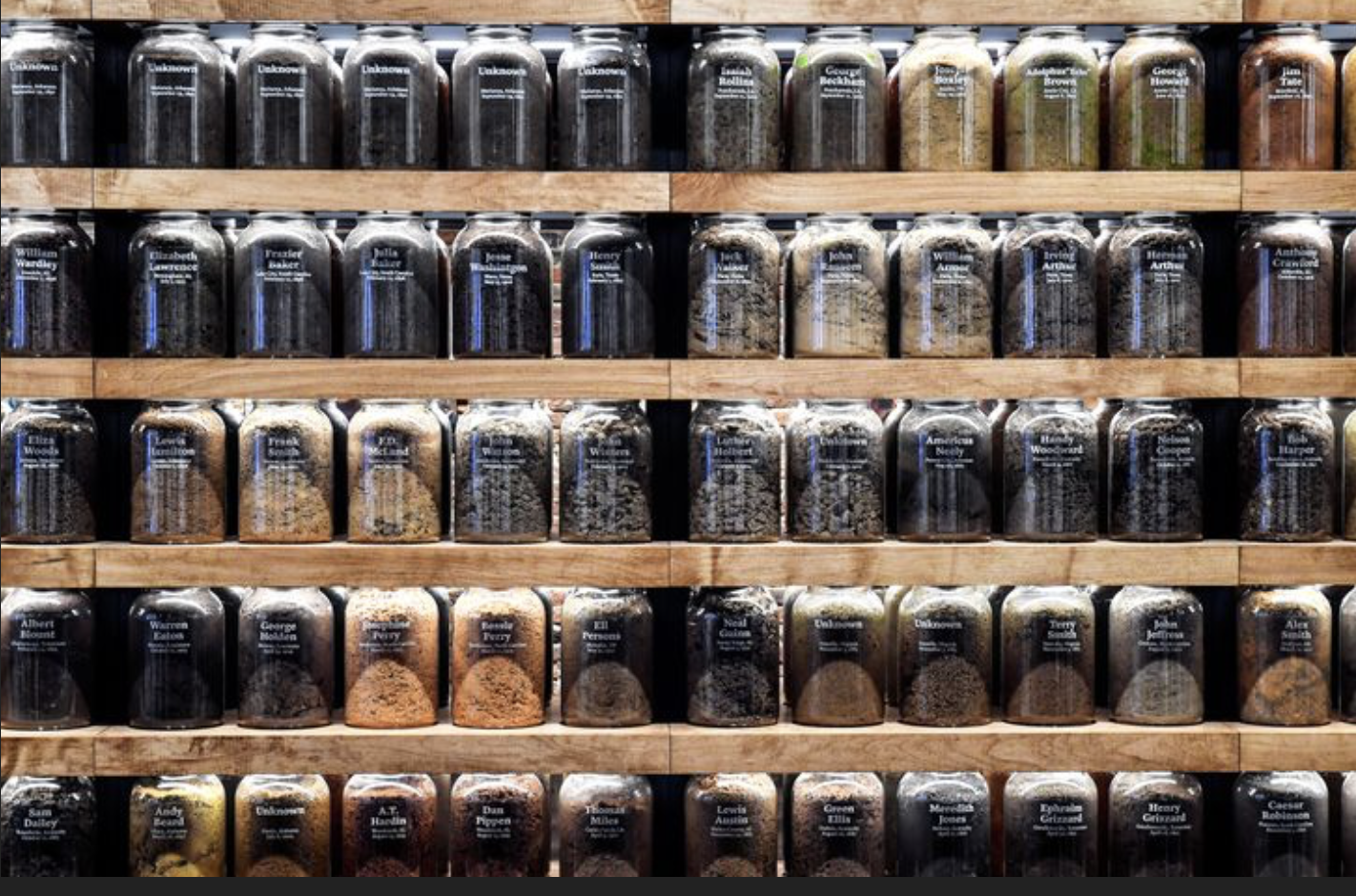
The Legacy Museum is intense. The first rooms give visitors a deep immersion in the transatlantic journey to the slavery auction block. Subsequent rooms bring to life the practice of separating families and the machinery of segregation. The final two phases cover the Civil Rights Movement and Mass Incarceration. I’ve never experienced anything quite like it.
I don’t usually leave Cleo for more than a few hours. So for this day trip, she was with me. We were both startled by the first room — a simulated experience of a slave ship. She found the lights and sounds of the multimedia exhibits disturbing, and I struggled to keep her calm. We exited sooner than I would have liked. There was simply too much to experience.
To fully absorb the Freedom Monument Sculpture Park and The National Memorial for Peace and Justice will require more time. I plan to go back. The museum doesn’t let you stay comfortable, and neither does this moment in history.
I’ll admit my laziness about my country. I’d read Howard Zinn. I knew the missteps. But I’d still been allowing myself the luxury of believing we were progressing toward something beautiful — that our IDEALS are SO BIG they would eventually win out. With the arrival of an administration intent on dismantling our democracy, it is no longer possible for me to minimize the ugly parts of our history.
Time to confront the original sins of stolen land from Native Americans. Time to confront a primary source of US wealth — the stolen labor of Africans. The Declaration of Independence expresses our highest ideals of equality for everyone. In contrast, the American dream of limitless acquisition exists in uneasy counterpoint to that ideal.
This July, America celebrates 250 years of that Declaration — a document written by enslavers, about freedom, that we are still arguing over.


Mark and I have been watching Ken Burns’s new series, The American Revolution. During the third episode, we were fascinated by the British statesman Edmund Burke’s warning to American enslavers. He advised them to be careful discussing freedom from British rule when enslaved people are within earshot. The revolutionary ideals those founders proclaimed unintentionally gave enslaved people a language for their liberation. This happened despite every contradiction the founders embodied.
I have a new thirst for American history. Thank you Heather Cox Richardson. The American people are rebels at heart. I tell myself that when the moment truly comes, they won’t tolerate fascism.
Who will the new heroes be? What alliances will form to preserve our democracy? I want to understand how we arrived at a place where fascism is a real possibility. The president commands a masked federal force. This force is paid for by our tax dollars. It is answerable only to him, policing the streets of Washington. Our country was founded by hell-raising rebels who threw off the rule of a king. The irony is almost too much to hold.
And yet it must be said: our democracy has not been working for many people for a long time. The 1960s civil rights struggle was a fight for equal participation in our established democracy. Now an angry, hate-filled movement wants to burn it all down. Immigrants, liberals, Democrats, Black Americans and Jewish people are all targets. A small but vocal minority openly identifies with the KKK.
The rebels who founded this country would recognize the moment. I hope we recognize it too.

Leave a Reply